
PROJECT RING_ZERO
Unified Spatial Computing Ecosystem consisting of Split-Compute Optics and Discrete Haptic Input.
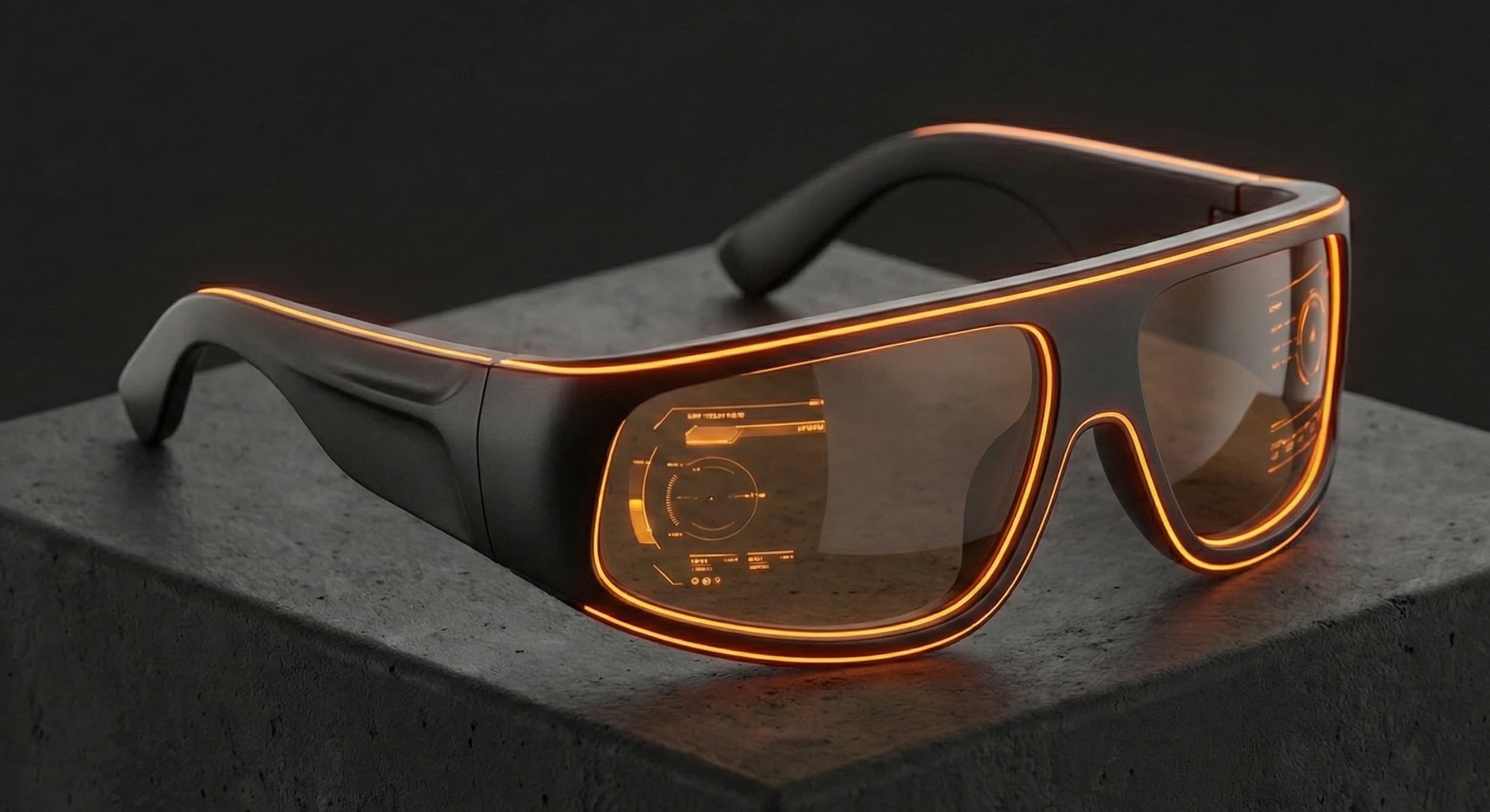
01 //0xLENS
Current Augmented Reality (AR) glasses face two fundamental ergonomic tradeoffs: the "Face-Weight Tradeoff" and "Gorilla Arm." Placing compute, battery capacity, and thermal hardware on the face makes the device heavier and less comfortable, while sustained mid-air hand gestures can fatigue the wearer's arms.
0xLENS solves this through SPLIT-COMPUTE TOPOLOGY. RING_ZERO Companion uses the wearer's compatible iPhone or Android phone as the primary compute host, allowing 0xLENS to remain a lightweight visual client.
0xRING keeps essential input at the hand: a compact, tactile controller that avoids relying on prolonged mid-air gestures for everyday navigation.
RING_ZERO ECOSYSTEM ARCHITECTURE
01.1 // HARDWARE ARCHITECTURE
HOST NODE (Phone)
RING_ZERO Companion supports compatible iPhone and Android devices. Wired display mode requires USB-C DisplayPort output; advanced rendering and on-device AI features vary by device capability.
TRANSPORT LAYER
Wireless mode uses a direct Wi-Fi link between phone and glasses. Attaching the USB-C cable replaces it with DisplayPort Alt Mode video, USB control, and USB Power Delivery.
CLIENT NODE (Lens)
Drives the microdisplay, collects inertial input, and manages local audio, controls, and power. Rear-temple cells balance the lens-side electronics while the phone remains the primary computer.
THREE POWER PATHS
0xLENS can run from its integrated rear-temple battery for short untethered use, from the optional 0xLINK neckstrap pack for extended wireless sessions, or from a compatible phone through the wired USB-C Power Delivery connection.
ENGINEERING COMPONENT PATH
Qualcomm Snapdragon AR1 Gen 1
AR-focused wireless platform with Wi-Fi 7/Wi-Fi 6 and Bluetooth support for the 0xLENS client, audio, and local sensor path. RING_ZERO Companion remains the compute host.
Two Sony ECX350F microdisplays
Two 0.44-type Full-HD OLED microdisplays—one per eye—with MIPI DSI input and up to 120 Hz operation, paired with the 0xLENS optical module.
STMicroelectronics LSM6DSV32X
Compact 6-axis IMU with embedded motion processing for head orientation and motion input to RING_ZERO Companion.
TI BQ25185
1-cell, 1 A charger with power-path management, thermal protection, and battery-temperature monitoring for the matched 1,000 mAh frame pack.
Near-ear audio + Bluetooth audio
Open-ear speakers provide ambient-aware listening, while paired Bluetooth audio provides private playback.
TI TPS65987DDK
USB Type-C and Power Delivery controller for cable orientation, PD negotiation, and DisplayPort Alt Mode configuration in the wired 0xLENS link.
01.2 // LOW-LATENCY TRANSPORT
A transport path built for the display
0xLENS normally receives the phone's rendered experience over a direct Wi-Fi link. When the phone is cabled to the glasses, the direct wired display link takes over and Wi-Fi is no longer used for display transport.
DIRECT WI-FI PATH
Wireless mode is a phone-to-glasses peer link. Wi-Fi carries rendered visual data; Bluetooth LE remains reserved for 0xRING control and low-rate status.
USB-C DIRECT LINK
A full-featured USB-C cable moves video through DisplayPort Alt Mode and may negotiate power through USB Power Delivery. The phone must expose compatible USB-C display output.
SPLIT COMPUTE
The phone renders the workload. 0xLENS presents the result, manages its display and local sensors, and draws from its balanced frame pack or 0xLINK neckstrap.
01.3 // OPTICAL ENGINE
Waveguide Optical Engine
0xLENS uses two Sony microdisplays—one per eye—as its image sources, with relay optics and waveguide combiners that place the images in the wearer's view while preserving a transparent glasses form factor.
- Display module: Two Sony ECX350F 0.44-type Full-HD OLED microdisplays—one per eye
- Image path: MIPI DSI display drive → relay optics → waveguide combiner
- Panel resolution: 1,920 × 1,080 per eye
- Panel refresh: Up to 120 Hz
OLED Microdisplays
Each ECX350F is a Full-HD OLED microdisplay designed for AR glasses. Together, the two compact panels provide the visual sources for the 0xLENS optical module.
01.4 // SENSORS & INTERACTION
The LSM6DSV32X 6-axis IMU supplies head orientation and motion input to the Companion experience. It is used for responsive display behavior rather than a claim of standalone room mapping.
> MODE: IMU + SENSOR FUSION
> INPUT: HEAD ORIENTATION + MOTION
0xRING provides the primary discreet control path through capacitive input and haptic confirmation. It keeps the user's hands relaxed while they navigate the Companion workspace.
> CONFIRMATION: LOCAL HAPTICS
> LINK: BLUETOOTH LE
An ambient-light sensor informs automatic display brightness adjustment, helping the optical system remain comfortable across changing indoor and outdoor light.
> OUTPUT: DISPLAY BRIGHTNESS
01.5 // RING_ZERO COMPANION & DEVICE SOFTWARE
RING_ZERO Companion is the Android and iPhone application at the center of the system. Its RING Spatial Runtime presents the workspace and manages the phone-to-glasses connection through supported platform APIs.
- 01. NATIVE HOST APPLICATIONRING_ZERO Companion uses supported Android and iOS graphics, display, and connectivity APIs
- 02. RING SPATIAL RUNTIMEThe app layer manages workspace rendering, device pairing, and feature availability
- 03. DEVICE FIRMWARE0xLENS firmware manages display, power, sensors, and links. Inside 0xRING, a hardware-protected wallet domain manages authentication, policy, and signing, while a dedicated controller domain manages refined gesture commands, haptics, and Bluetooth LE.
01.6 // MATERIAL SCIENCE
02 //0xRING
02.1 // THE "GORILLA ARM" PROBLEM
Current spatial computing inputs rely on mid-air hand gestures or purely optical eye-intent. These modalities suffer from high social friction ("looking weird in public") and physiological fatigue ("Gorilla Arm"). Furthermore, eye-tracking alone lacks the mechanical confirmation required for precise confident clicking.
"The best input is the one nobody sees you perform."
02.2 // WALLET-FIRST MICRO-GESTURE CONTROL
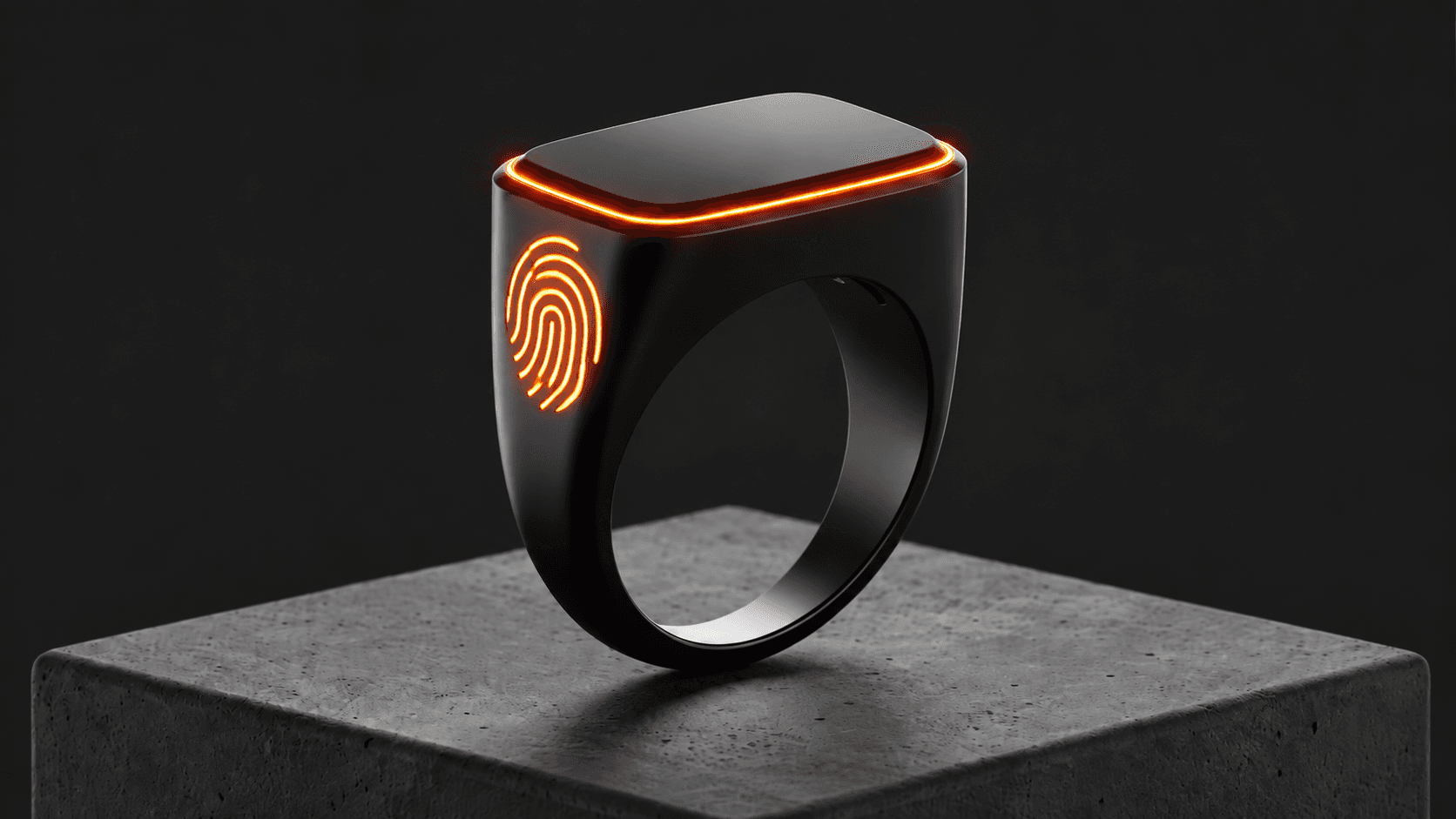
The 0xRING is a hardware wallet worn on the index finger. A thumb-accessible fingerprint sensor verifies local wallet access.
The same side-mounted secure thumb interface supports fingerprint authentication and discreet swipes, taps, and holds. Fingerprint matching and wallet confirmation remain inside the protected wallet domain, while the dedicated controller domain receives refined navigation commands.
CAPACITIVE CONTROL SURFACE
The capacitive outer surface turns deliberate thumb swipes, taps, and holds into familiar navigation commands—without requiring a raised hand.
FINGERPRINT WALLET ACCESS
A thumb-accessible sensor verifies local wallet access. The ring access code remains the deliberate fallback, while a separate confirmation approves every signature.
LRA HAPTIC ENGINE
A linear resonant actuator produces a brief tactile click for each confirmed interaction, providing physical feedback without visual distraction.
BLUETOOTH LE CONTROL
Bluetooth LE links 0xRING to RING_ZERO Companion for low-rate control and status. Visual transport remains on the direct Wi-Fi or USB-C display link.
HARDWARE WALLET ARCHITECTURE
SECURE ELEMENT ARCHITECTURE
0xRING keeps wallet signing as its primary role. The secure element creates and uses private keys internally; Bluetooth transports transaction requests and signed responses, never private keys. Fingerprint verification or the ring access code unlocks local signing, and a separate physical action confirms each transaction.
HARDWARE-LEVEL WALLET ISOLATION
0xRING places the NXP SE050 and wallet authorization path inside a hardware-protected domain. This domain exclusively controls fingerprint authentication, access-code validation, signing policy, transaction confirmation, and private-key operations. A dedicated controller domain manages Bluetooth LE, haptics, and refined gesture commands.
RING_ZERO Companion, 0xLENS, and Bluetooth connect through the isolated request interface. They can prepare a transaction request, while local authorization and secure-element signing remain exclusive to the protected wallet domain.
0xRING pairing and transaction review are managed through RING_ZERO Companion; the website's web-wallet connection is separate.
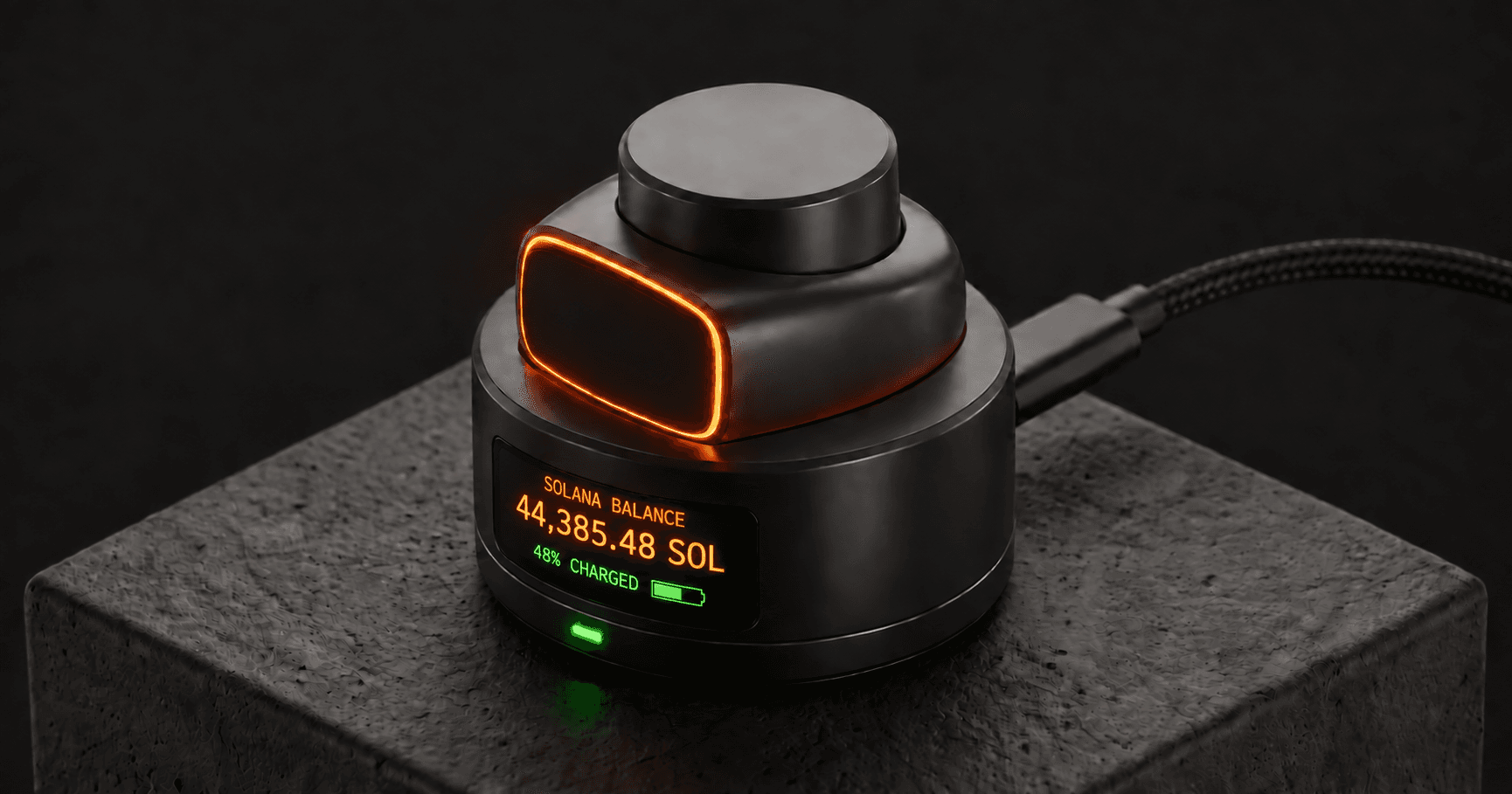
During setup, the phrase is shown on the ring's dock display for owner verification; it is never stored by RING_ZERO Companion or RING_ZERO services.
TECHNICAL SPECIFICATIONS
02.3 // OPERATIONAL PARADIGM
The 0xRING paradigm shifts interaction from "Overt" to "Covert". Designed for "Pocket-Computing", it enables users to navigate complex spatial interfaces with their hand completely relaxed at their side. Unlike mid-air gestures that require physical exertion and draw social attention, 0xRING inputs are almost invisible to the outside observer.
A proprietary "Tactile Lexicon" provides rich non-visual confirmation. A sharp 'tick' signals a scroll step, a rhythmic 'pulse' indicates urgency, and a heavy 'thud' denotes a system limit. This allows users to build muscle memory and operate the system purely by feel.
0xRING material engineering balances RF performance, structural durability, finish, and skin contact so the wallet remains comfortable enough to wear and reliable enough to use every day.